Novices
Michelle Ross
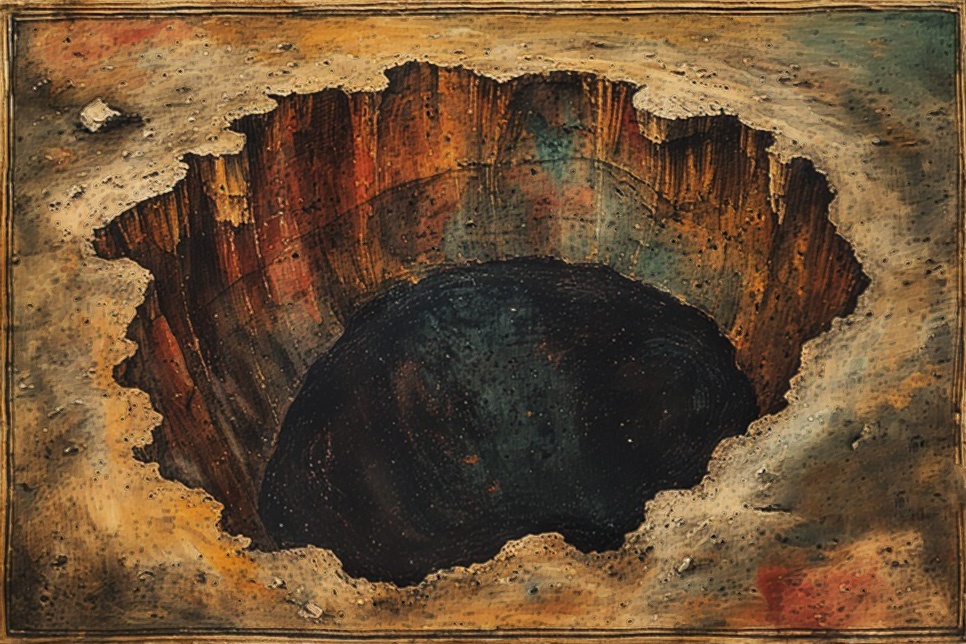
The sinkhole wasn’t something you might stumble into as you were hiking the trail. To see into it, you had to step off the trail and up onto higher rock. But once you did that, once you were looking down into the sinkhole—600 feet down, according to a sign—there were no guardrails, no netting. Nothing to stop you from tumbling in, cracking your skull open like a geode. Devil’s Kitchen was all rock. Nothing like what I pictured when I encountered the word “sinkhole.” As if only soft things could collapse in on themselves.
I’d gone on this hike with my husband, Tom; our son, Lucas, who was 14; and Tom’s father, Harry, and stepmother-in-law, Darlene. Harry, and Darlene had recently moved to Sedona. The house they’d bought was neither small nor remote. It must have cost them a fortune. Tom and Lucas and I had driven down for a long weekend.
Every hike that weekend, Lucas performed stunts on those red rocks that caused me to picture him tumbling to his death. Picturing our son dying was old habit. I’d been doing it since before he was born, before his will had anything to do with it. Still, I didn’t like how close he stood to the sinkhole’s edge.
I said, “Please don’t stand so close to the edge.”
Lucas said that perhaps I shouldn’t stand so close to the edge. He reminded me that the only person who had injured themselves that weekend was me.
I jumped off a boulder after Lucas jumped off. He landed gracefully. My boot caught in a crevice. My shin swelled like something fertile. The look on Lucas’s face: It was one that had become increasingly familiar, a mixture of pity and wonder.
About as soon as Lucas rebuked me, Darlene joined him at the edge. That was Darlene in a nutshell. She and Harry were in their late 70s. I suppose that means they were elderly, though the word felt wrong. They were as active as ever, especially Darlene, who played pickleball competitively and walked to the grocery store every day to buy ingredients for dinner. I considered how “active” is also used to describe volcanoes and yeast.
Lucas asked Darlene if she thought about death a lot.
Tom, who had been lamenting how old he was since I’d met him over 20 years ago, immediately scolded Lucas. “That’s not a nice question.”
That was Tom in a nutshell. He had a knack for saying the wrong thing—for turning a moment that had been fine to everyone but him into an awkward moment for us all. In such moments, I felt somehow responsible for him, as though I had made him. Marriage could be embarrassing like that.
Lucas said, “Why’s that?”
Before Tom could answer, Darlene, bless her, said, “I do. Do you?” She looked down into the sinkhole’s abyss.
Tom’s father, Harry, was busy reading the information placard that told about the formation of the sinkhole, its history. He’d put on his reading glasses, which he carried in his shirt pocket everywhere he went. His finger was on the placard. I don’t think he heard a word.
Lucas said he thought about death a lot, too. “Like right now I could step off this ledge.” Then he said, “I like the trails around here. They’re not boring.”
That was 14-year-old Lucas in a nutshell. The 14-year-old part is key. In fact, maybe I should say that was 14-years-and-9-months Lucas in a nutshell. Who knew what next month would bring?
I liked these hikes for the same reason as Lucas. Or maybe not quite the same reason, given Lucas’s sure-footedness, his brash confidence—the fearless sheen of youth. The trails we hiked that weekend were rated moderate yet contained treacherous stretches that made me feel like a novice. Those who created hiking trails relied on the rest of us to know what the hell we were doing when much of the time we did not. And even if we were knowledgeable, nature was unpredictable. Rocks shifted and slid. Storms appeared out of nowhere. Snakes, too. The earth beneath you could collapse in on itself. And wasn’t that all part of the appeal? To remind yourself how vulnerable you are?
Around the time we were gazing into that sinkhole, a woman, a young mother, fell to her death on another hiking trail in Sedona, though I didn’t know that yet. I would read about it the next morning as I drank coffee on my in-laws’ balcony, which afforded a spectacular view of these stunning, wild rocks. The woman was hiking with her husband and young child, who both survived. I would recognize the name of the trail. It was one we hadn’t gone on. Rated as difficult. I would wonder if the woman had considered herself an experienced, knowledgeable hiker or if to her a hike was just a walk in nature, nothing warranting any particular experience or knowledge. I would wonder if there’d been a moment, perhaps many on her last hike, in which she gazed down from those red rocks and recognized that she knew nothing. I would wonder if that recognition thrilled her.
Table of Contents
|