The Mouse
Adelaide Gifford
It’s midnight now. I wrap a towel around my chest and step out of the shower, pulling the glass door closed quietly behind me. It’s so dark I can’t see a thing, but I don’t turn on the light, too afraid I’ll wake my sleeping family nearby. I inch down the hallway, past my sibling’s room, past the large windows that shine with a slight blue tinge from the moon outside. I shuffle through the living room, to the kitchen, and take my phone from the shared charging station.
It flashes on, the battery symbol yellow and indicating 20 percent. Enough to survive the night? I told my dad that he doesn’t need to wake me in the morning—after all, I’ve been in college for a year now, and I was always on time to class. Still, he doesn’t want to risk my sleepiness making us both late for work, since he’s the driver. He calls to me each morning to check that I’m up and moving.
My plants are still on the kitchen counter, just where I left them two weeks before. We’d gone on vacation, and I didn’t want any interim waterers to have to brave the mess of my room—the only room on the second floor—to take care of them. Now I bring a few up each time I go upstairs.
Before I reach the plants, I turn my phone’s flashlight on. It’s weak, but gives me more than I had a moment ago. I make it past the fridge without error. Double whammy, I realize—I took out my contacts before showering and my glasses are still upstairs. It’s blurry and dark.
Maneuvering about the kitchen with minimal vision, I’m reminded of how, when I was younger, I would walk around with a book in my face. There was one week, around third grade, when I walked into the kitchen in the morning, so focused on my reading that I stumbled right into the open dishwasher door. I remember proudly showing off the dark bruise on my ankle to all my friends on the bus. I’d decided it probably wasn’t the smartest idea to read while walking. Of course, the next day I did it again. This time, I fell forward, just inches from a knife (sharp-end pointed up!) put in the dishwasher to be cleaned. From then on, I made sure all knives in the dishwasher were pointed down.
Before I reach the plants, I’m distracted by the caterpillars in the water glass beside the fridge. A couple of weeks ago, I found a tall-grassed meadow, cut through by a walking path packed with milkweed. I spent nearly an hour inspecting the undersides of each leaf, searching for the tiny, striped squiggles of newborn caterpillars, or the off-white crystals that were their eggs. I ended up with two babies—not yet as long as my pinky finger nail (which, for reference, I bite incessantly)—and an egg. Somewhere along the way, a fourth appeared. Perhaps it’d begun as an egg on a leaf I was feeding the others, that I just hadn’t noticed, or maybe I’d miscounted in the first place. Either way, the other caterpillars and I had welcomed it into the fold.
I’d set them in a regular drinking glass by the fridge, partially filled with water to keep the milkweed leaves I gathered from wilting. The leaves stuck up, out of the water, and the caterpillars tended to stick to their food source, though I’d left them with access to the rest of the world —partially, perhaps, out of laziness at the prospect of building a more secure home, and partially because it provided proof that they wanted to stay in the haven I’d created. A few days into their stay, I’d cut holes in a piece of paper towel and used a rubber band to secure it to the top of the glass, so the leaves stuck through into the water but my tiny, crawling tenants remained on the dry side. From there, I’d observed the caterpillars, donned each one with a name I felt suited it best.
There was Jewel, the first to transform into a chrysalis. Now she hung from the underside of a leaf like a perfect emerald. Fragile and regal. Monarch chrysalises, I figured, held the most golden shade of gold found in living nature: little dots that speckled the outside of the chrysalis in a pattern that never varied from one to another.
Next was Bilbo, who’d trekked up and down the milkweed and across the stick and the glass that held it and over the counter and through the kitchen and back to the paper towel I’d wrapped around the cup to keep them from falling into the water, where he finally made his chrysalis.
And a younger caterpillar I called Naiad. One morning, I’d come downstairs to see her floating on the surface of the water in the glass. I’d fished her out, then put her on the counter beside the glass, prodding her delicately with the tip of my too-fat finger. She’d felt mushy, somehow sloshier than usual. As if the taut caterpillar skin had gotten waterlogged.
“You gonna give it mouth to mouth?” My mom had asked from where she was brewing her morning tea across the counter.
“Yep.” I’d moved the caterpillar to a paper towel, hoping that, somehow, the near-dead creature might be revived if the towel could suck up some of the water from her system. I snipped the tip of a leaf to feed her if—when—she woke. There was a crumpled bit of black, semi-translucent something hanging on the underside of another leaf and I pinched it off. Caterpillar skin. My bet was she’d been shedding, and had fallen straight out of her old skin and into the water. Otherwise, she’d have eaten the skin. What a rude awakening that must’ve been.
I’d placed the shed skin beside her, and nudged her once more. This time, she’d reared, pulling her head into her body like a human coming back, coughing up water and pounding their chest to dislodge the sea. She was alive. I christened the square of paper towel “The Caterpillar Hospital” and left Naiad there to recover. She’d come away from the incident with only half an antennae and strange tics that made her head spasm every now and then as she ate.
Last was Steve. Steve got his name from my sibling, playing Mario Kart with their friend. I’d asked for name suggestions and the two had briefly looked up from their game, shouted “Steve!” in unison, high-fived, and then returned to the race. It seemed meant to be.
These caterpillars were a part of me now, and not just because I’d raised them since just after their hatching. Bits of their being were literally inside of me because, well, I’d accidentally eaten some of their poop. Frass, for those in the know. I always put my own water glass beside the fridge, where I kept the caterpillars. A few days before, I innocently drank some water, recovering from being stung by a wasp, then a bee, in a matter of minutes, when I tasted something nearly flavorless yet unmistakably spongey. I looked down and noticed bits of frass floating on the surface of my water glass. Maybe I was just telling myself I was connected to the caterpillars so I’d feel better about eating their poop. Whatever works!
Now, in the nighttime darkness, I check that all the caterpillars are safe and accounted for, as I do every time I pass them. I can hear Naiad’s rushed chewing as she tries to catch up to her siblings, to store enough energy to build a chrysalis. I hope she makes it despite her near-drowning.
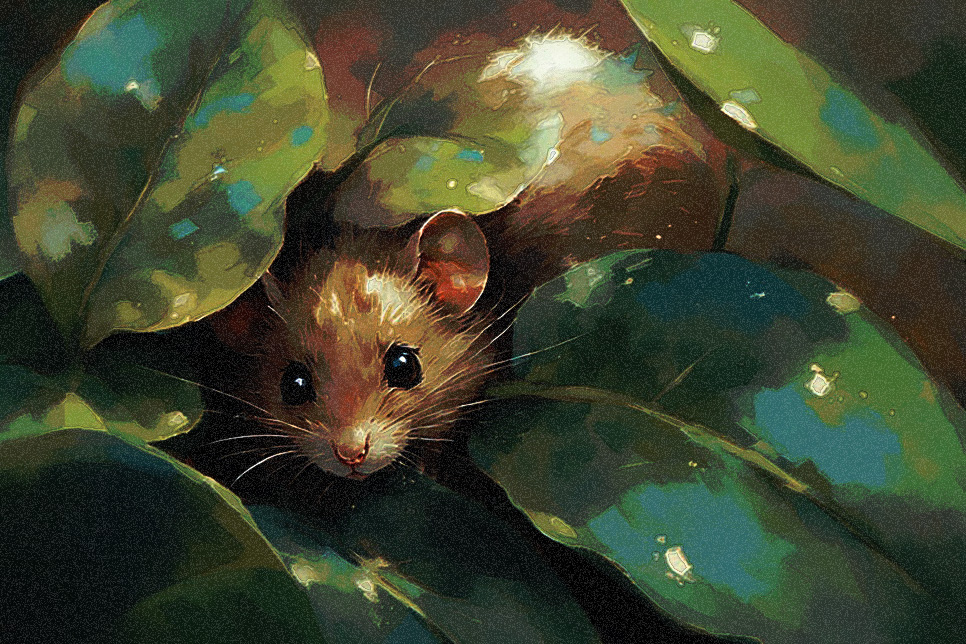
I notice two beady, black eyes, nestled in slick, shivering, shadowed fur, watching me from the trough that my mom keeps a few of her plants in: a begonia; a succulent she’s named Chakra because, according to her, its chakra is blocked; a few airplants I gave her for her birthday. The creature is breathing heavily, quaking almost undetectably, and I move so my flashlight hits it more directly: a mouse. A ball of fur, really, curling in on itself, nearly shapeless but for the whip of its tail and its intensely afraid eyes.
I fumble with my phone to pull up the camera. Why is that my instinct? Why am I desperate to capture every glimpse of nature I get on film, instead of just sitting and enjoying it in real time?
When I open my camera, the flashlight turns off and I’m left in utter darkness yet again. I feel for the light switch on the wall, but I’m too late and the mouse is gone. Maybe I imagined it all along. I’ve imagined stranger things.
Then I see it again, hiding on the windowsill. Its fur is brown, almost amber. Its eyes lie close together on its face, its tail dark and stiff, and its ears are pressed flat against its body. I can tell that it’s trembling slightly. It wasn’t expecting me, this giant alien creature, to emerge from the darkness. I can’t imagine its past experiences with humans have been all that good.
I can’t just leave it here, that much I know. If my mom found it in the morning, she’d be upset and desperate to find a way to rid our house of the suspected infestation. If we still had a dog, maybe she would’ve already scared the invaders off.
I’m nothing if not a country mouse. I catch toads in my bare hands, raise tadpoles into frogs, pick bees off of flowers and let them nap on my fingers, hatch chickens from eggs and raise them in a cardboard box beside my bed until the smell of chicken poop is instilled in the fibers of my carpet, immune to any cleaning. I’ve seen my fair share of mice. I can hear their scuffling in the walls above me at night—or maybe that’s squirrels building nests in the insulation. A few weeks ago, I ventured into a closet we don’t use, only to discover a healthy layer of mouse poop coating everything. The only mouse I hate is a dead one.
Still, I’ve never been trained on what to do at midnight, when you’re the only one still awake, and there’s a mouse loose in the kitchen.
I know what not to do.
If you have a mouse loose in your house, don’t throw a tennis ball at it. You might have better aim than you thought. And then … smush. Mouse guts everywhere.
Instead, I pick up a small glass vase my mom uses for flowers cut fresh from her garden, and an empty plastic carton that once held parmesan cheese. I try to corral the mouse into the vase, but it politely declines and scurries back into the plant trough, leaping off the windowsill.
I can hear a buzzing coming from the metal floor of the container, like a bee-sized rattlesnake is trapped within the mouse’s fur. Its heartbeat reverberating off the trough, perhaps? The poor creature is petrified.
It cowers behind the begonia. I place the clear vase on one side of the plant, and use a dulled pencil to try and usher the creature into it. I wish it could understand me when I tell it I’m not here to hurt it. Its eyes are wide, nose and whiskers twitching frantically.
I give up on that attempt, shed my towel, and it falls to the kitchen floor. Fully naked now, I don oven mitts. A friend of mine just got back from France, where she was bit by a bat. She told me the rabies vaccines were the most painful shots she’s ever gotten, and I’m not risking a mouse’s nibble if it means I have to get them, too.
If the neighbors looked out their windows right now and saw me, what would they think? How would they rationalize the image of a girl standing in the doorway of her house, naked and squinting, wearing large, red oven mitts, and holding a pale blue trough-like tray filled with plants?
I hold the trough at arm’s length, so as not to provide the critter with a direct ladder to my face. Nature seems to have a penchant for going for my face, what with the recent rooster bite on my upper lip, or the bee sting that made my eyelid swell to twice its size. I shuffle to the front door, watching the mouse press itself to the teal metal, eyes darting and terrified. The lock is sticky, and I have to juggle the trough in one hand, pull an oven mitt off with my teeth to get it open.
I set the tray down on the porch, removing Chakra and figuring that, if I empty the tray, I can tip it over so the terrified mouse has to get out of its hiding place. Have I heard any owls tonight? Or the cacophony of coyote voices I can often hear in the woods behind my house? It’d be a shame for one of them to catch the critter, but, I suppose, better than curling up and dying a slow, scared death between my mother’s plants. Inside, it would serve no purpose but to make my mom shriek when she sees it. Anyway, it probably knows a way into the house so small I’ve never discovered its existence. As long as I’ve done my best to hide it from my mom, I don’t really mind sharing my space with it. Afterall, we’ve encroached on nature’s territory more than enough.
When I lean forward, and my shadow falls on the mouse again, it leaps from the tray and disappears into the darkness. I silently bid my short-term friend adieu, collect the trough, and return inside the house.
Upstairs, I’ll lie in bed for a bit, letting a bug crawl across my arm. I’ll wonder what it’s like to be that small. It must feel like everything is an obstacle to be conquered. I’ll guide the bug onto the bureau beside my bed, and turn to look at the wisteria branches bursting through the crack between the air conditioner and the side of the window. A spider has built its web on one of those branches. I want to curl into a ball, smaller and smaller, forget my human responsibilities, and watch the caterpillars transform to chrysalises, emerge as butterflies, the plants unfurl fresh leaves in the sun, and the mice scurry across the floor in the middle of the night.
Table of Contents
|